
Dispatch No. 25 ← Previous ↰ All Next →
TL;DR; §§ 101, 102, 103, and 112


The recap: § 101 (is it even an invention?), § 102 (is it new?), § 103 (is it obvious?), and § 112 (did they actually teach it?) — three grounds I'm raising (§§ 102, 103, 112) plus a § 101 discussion, across four dispatches, one short recap. This is the meat & potatoes of the PGR.
Background — part of my pro se Post Grant Review of U.S. Patent 12,460,537, which I believe copies rotation-sensing I disclosed first. This one is the one-page recap of the four sections — § 101, § 102, § 103, and § 112 — the meat of the PGR. New here? Start at Dispatch No. 1.
This is exhausting
I'm an inventor, I shouldn't be explaining the significance of terms like "expressly" or "inherently" or legal theory. I'm wholly unqualified for that. Plus, I have better things to do, and hopefully you do too. Here's the recap.
Also, for anyone who got through all the other posts, if I ever meet you in person, let me know and I'll buy you an adult beverage… or a beverage of your choice.†
† Terms: only good for one, subject to change without notification. But either way, thanks for taking the time to read them. ↩
§ 101 — Is it even an invention?


§ 101 isn't a big win for me here, and I'm not pressing it as a ground in the PGR — it's a discussion, not a door I'm knocking on. My real issue with this application is in how they phrase it as the magnetic field makes a sine wave, and the linear motion is a sine wave, so that's the invention. The real argument falls under the other sections; if you did look at it through a strict § 101 lens, you could frame it as a bare correlation dressed up as an invention — but that's a framing I'm raising for discussion, not a conclusion I'm asking anyone to rule on. Feel free to argue otherwise. I'm open to corrections. Mostly I'm just sad the examiner didn't even take a look — there was good reason to — so chalk it up as one more thing examination never reached. It stays commentary; the real grounds are §§ 102, 103, and 112.
Full version in Dispatch No. 21.
§ 102 — Is it new?


Each of two references — my own publication and Fyfe — anticipates on its own; expressly and inherently. Inherently is the operative word and if you read the full post, you'll see the shenanigans the applicant pulled by conveniently omitting this key term during the correspondence. This, combined with all the other shenanigans, deserves another TL;DR; post. Stay tuned for that one.
§ 102 was the key objection from the examiner, and it's a good one. It strongly applies here. It's baffling how the examiner rolled over on this one. In the petition it rides in the alternative, though — § 103 leads, because my § 102 read of claims 1–12 depends on the Board adopting the patentee's stroke construction, and § 103 holds either way. (Claim 13's § 102 is the exception — no “direction change” language to construe — so it's the cleanest anticipation shot.)
I'll paraphrase their argument here. It goes sort of like this: I don't say the thing exactly how they say it. They say their novel step is to detect rotation only during a stroke which is defined by 3 direction reversals. Again, feel free to correct me or help clarify things. This is the recap, so I've condensed it considerably.
§ 102 says anticipation means a single prior art document has to disclose every element of the claim, arranged the way the claim arranges them. (The legal phrase is "arranged as in the claim," not "listed in the same order" — a subtle but real distinction.) I think my paraphrasing lays out the elements, arranged just that way.
My paragraph [0082] is important. I say "An accelerometer can be used to detect the accelerations imparted by the directional reversals caused by stroking action." I also talk about the magnetometer in this same paragraph "The magnetometer experiences a range of field distortions as the sensor moves closer and further from steel objects in the pumping system. Short term variation in the magnetometer readings can therefore also be indicative of stroking action."
The examiner didn't cite [0082]. But [0029] was cited repeatedly by the examiner. Here's what [0029] says: "In this instance, the accelerometer and gyroscope are configured to determine immediate rotational deflection of the bridle assembly during the course of a single stroke by way of an inertial reference."
If you forget about [0082] (or never read it), [0029] states it implicitly — here I "detect rotation only during a stroke," so from there all you need is to know what a stroke is. I'd call that "obvious" but that goes to § 103. For the § 102, you just need to look at my paragraph [0082] where that is stated explicitly.

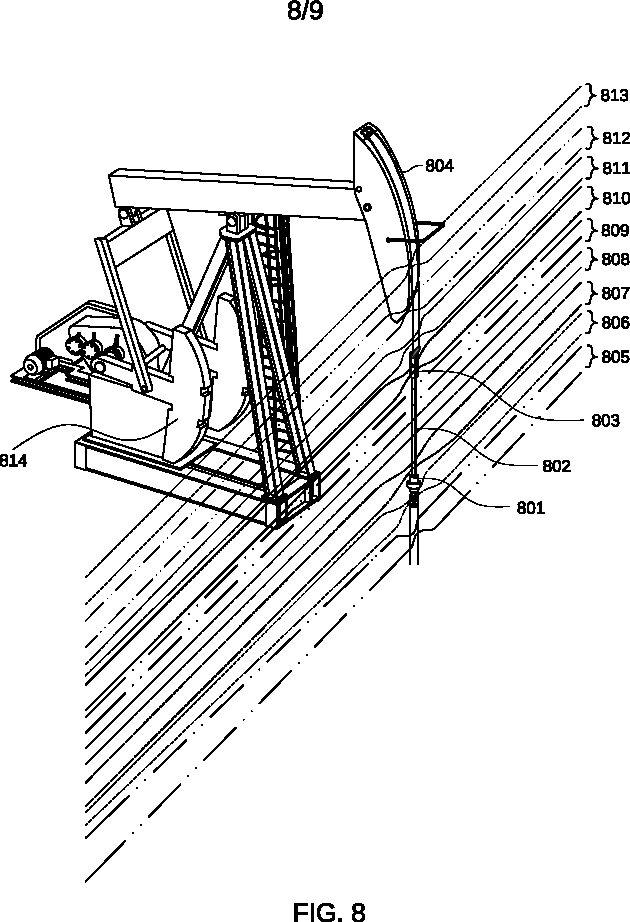
And if you still don't believe any of this, look at my Figure 8. A picture is worth a thousand words. This one should at least be worth a few dozen. Look at the field lines I drew relative to the linear positions. This is the how. This is missing from their disclosure, and that goes to § 112. But in the strict § 102 sense, this inherently captures the stroke. You can see it right here. All you need for § 102 is my paragraph [0029] which calls out the rotation sensing bound to a stroke, and either [0082] or Figure 8 (but I provided both!) to get that the stroke is parsable by the magnetometer. These are all the elements, arranged as the claim arranges them — one reference, no combining. It's simple enough to follow without specialized training, though the petition still supports every ground, this one included, with the expert declaration. This is textbook § 102.
Full version in Dispatch No. 22.
§ 103 — Is it obvious?


§ 103 is broader. If you believe the argument that I didn't say everything exactly like they said it (and if you fall for the argument that I did not explicitly recite the conditions for the starting and stopping events, which is not the bar for a § 102) — then § 103 asks whether this is obvious. That's an easy ask. If you have a thing that goes up and down, is that motion naturally defined by 3 direction changes? Stated like that it's probably closer to a § 101, but in § 103 you can ask that of a POSITA. By now you're probably a POSITA and should be able to answer that basic question. To me the answer is plainly yes — and in the petition I don't just assert that, I give the reason a skilled person would combine these, supported by the expert declaration (obviousness needs articulated reasoning, not just "of course"). Now you only need my paragraph [0029] that says I bound that sensing to the single stroke.
§ 103 lets you combine those as obvious. Why? Because they are obvious. I already disclosed it and any supposed missing piece does not require a leap to get there.
In fairness, the Final OA added a § 103 for some of the claims. That office action was a mess of typos, so (in my opinion) an internal review should be performed, just for the sake of integrity. But that's not how this system works.
The real § 103 should have been Fyfe, on all claims. § 102 works there too, but if you want to say the elements aren't arranged exactly as the claim arranges them, or they used the term alternative embodiment, § 103 works perfectly here. That's before you bring in other references which is also fair game in § 103.
And the examiner already had Hurst — he used it during prosecution to reject the tubing-rotator claims. I even talk about Hurst in my own disclosure, so the motivation to combine was sitting right there in front of everyone. To be clear, Hurst isn't a ground I'm raising in the petition: the examiner already considered it, so building a fresh § 103 on Hurst would just draw a § 325(d) “we already looked at that” denial. I flag it here for what it shows — how well-known this all already was.
I didn't catch this one when I wrote up the § 103 post.
From the applicant RCE:
[Their RCE Arguments, in the § 103 section, referring to the § 102 section]
Claims 8 and 9 depend from claim 1 and are allowable for at least some of the reasons discussed above. Hurst does not remedy the deficiencies of Phillips noted above.
I just reread Hurst and there are some interesting lines that underscore how obvious this already was (note: this didn't make it into the § 103 post).
[Hurst [0007]]
With each stroke of the pumping unit, the rotator may rotate the rods a fraction of one revolution.
OK, so it's obvious that the rotation occurs during a stroke. So you'd want to sense this during a stroke. This was in the background section. Plain and obvious and again, even if you still believe I don't state everything, here's the combination.
And this. Here's another definition of the stroke. Another way to write it, but meaning the exact same thing as the direction change nonsense. For the record, this is a much more common and traditional way to describe the stroke. We further split the stroke into its up and down phases because interesting things happen on each of those. What happens between up and down? Yeah, a direction change. It's right here.
[Hurst [0018]]
wherein the motion of the pump plunger 110 comprises an “upstroke” and a “downstroke,” jointly referred to as a “stroke.”
In short § 103 has a lot of ammunition, but only if you don't believe I disclose everything "expressly" or "inherently". I think § 102 was much stronger, but the lack of § 103 pushback from the examiner on the key claims is troubling.
Full version in Dispatch No. 23.
§ 112 — Did they actually teach it?


§ 112 is the one ground I could only raise here, in the PGR — the preissuance submission couldn't touch it (it's limited to prior art), and an IPR can't reach it either. This should have been questioned during examination, but hey, we're here because of a failure in examination.
And it's the cleanest of the four. §§ 102 and 103 are a fight about my disclosure and the prior art — § 112 isn't. It's judged entirely on their own four corners: it doesn't matter what I disclosed or what any reference says, only whether their spec teaches what their claim covers. There's no prior-art fight to have, because the hole is inside their own document. That's why, of the four, it's the one I'd bank on.
§ 112 in simple terms asks if the disclosure actually discloses the things they claim — and, separately, whether the claim is even clear enough to know what's covered (that's the definiteness piece). You should go read it. Actually, go read both, here's the link: "thin joints of steel bar that are threadedly connected through couplings".
The first thing you should notice is there are only 3 figures, one of which is just an overview/background. Another is a generic block diagram of a sensor system (obvious on its face). The third figure is a 3-step flow chart. No indication this is a repeating process, which is a critical flaw. You might say that's obvious, but if you say the sensing "ceases," that's all it says — nothing in their disclosure tells a reader it then repeats.
I happen to think this is a very complex and nuanced problem to solve. That's why my disclosure is easily 3x the length of theirs. Length has no bearing on quality or whether things were disclosed or not, but it's a big clue. One that helps frame this as a § 112. Did they actually disclose what they claim? I think the answer is clearly no.
First and obvious is the added material about the "previous stroke" that appeared in the Amended Claims after the final. You can read their disclosure, search for any notion of a "previous stroke". Not disclosed, a clear § 112… but you have to pay attention. The applicant remarks sure make it sound like it's in there, doesn't it?
How you turn a magnetometer sine wave into a direction change is also not disclosed. That is a bare correlation without enablement.
You can only confirm a direction change after it happens — but the claim acts "once" it occurs. How you close that timing gap is never disclosed. That's a big, unenabled problem.
Full version in Dispatch No. 24.
Bottom line
Three doors that actually sink the claim — §§ 102, 103, and 112 — any one of them does it (with § 101 along for the discussion). And § 112 is the one I could only get to through the PGR, and it's a big one. And honestly, the one that offends me the most. A workaround would have been fine, but this is a poorly disclosed hack. It doesn't even rise to a workaround.
Related dispatches
- Dispatch No. 21 — § 101 — What Even Counts as an Invention — the full § 101 eligibility discussion.
- Dispatch No. 22 — § 102 — Nothing New Here — the full § 102 anticipation case.
- Dispatch No. 23 — § 103 — Obvious to Anyone in the Field — the full § 103 obviousness case.
- Dispatch No. 24 — § 112 — They Never Said How — the full § 112 written-description / enablement / definiteness case.
- Dispatch No. 26 — TL;DR; All the system failures — the companion recap, covering the system failures instead of the legal grounds.
- Dispatch No. 27 — TL;DR; They were too long, so I didn't read them — the even-shorter recap, for when this one ran long too.
- Dispatch No. 28 — Let's Fix It — the closing dispatch, trading this recap's complaints for concrete fixes.
- Dispatch No. 33 — The PGR Petition — the petition that turns these grounds into the ones actually pleaded.
Discussion