
Dispatch No. 24 ← Previous ↰ All Next →
§ 112 — They Never Said How


§ 112 — the specification and claim requirements are the price of the patent bargain: the monopoly is only earned if the disclosure actually teaches the invention — described, enabled, and claimed with reasonable certainty. Theirs recites a result and skips the ‘how.’ It’s the cleanest ground I have — and the one I was never allowed to raise until now.
Background — part of my pro se Post Grant Review series on U.S. Patent 12,460,537, which I believe copies rotation-sensing I disclosed first, and the cleanest ground I have. This one says the patent flunks the basic bargain — it never actually teaches how to detect a direction change from the sensor signal. New here? Start at Dispatch No. 1.
§ 112 — The patent deal
Every other section in this series asks whether the claim is any good: is it eligible (§ 101), is it new (§ 102), is it non-obvious (§ 103). § 112 asks a different and, to me, more fundamental question — did they actually teach anyone anything? That's the whole deal. The Constitution (via Congress) lets the public hand me (the inventor) a temporary monopoly, but only in exchange for a real disclosure. That’s the deal. That’s the fair trade.
I get to make money for a limited time because I told you how it works, how to make my invention. And then, after that limited time, you all get to make my invention. Sounds great, right? (I haven’t seen a dime, for the record)
You all are supposed to benefit from inventors disclosing their inventions. That’s the theory at least…
What happens when the inventor doesn’t hold up their end of the deal?
The inventor has to describe what was invented, enable a skilled person to actually build and use it across everything claimed, and draw the claim clearly enough that the public knows what's fenced off. At the end of the patent term, you (the public) get that technology. So what if the disclosure is so vague and useless that no one can make or understand the invention? Well, if you hand out a bunch of patents to folks who don't actually disclose their "invention" we (society) have given them something for nothing. That is a problem. The patent office is supposed to be the gatekeeper, but they failed us all here.
Here's one of the many tragedies: the public good was not progressed by this garbage patent. Nothing was taught. Nothing was given in exchange for that monopoly. I got screwed now (because they got a piece of my supposed monopoly), but you all get screwed forever.
No § 112 Objections?
This should bother you as much as it does me: the examiner raised zero § 112 objections. Not one. I flagged that all the way back in Dispatch No. 2 — the application is chock-full of § 112 problems and not a single one was ever put to the applicant. An examiner not raising a single § 112 issue doesn't prove a lack of skill in the art — but in my reading of this record, it's hard to read it any other way. Either way, the § 112 problems went unexamined, and that's a problem in itself.
I had no way to raise it either — the only public tool the system provides before a patent issues structurally can't touch § 112. I'll get into exactly how that trap is built below. For now, the point is that everything that follows is being said here, in a PGR, for the first time — at the only moment the system allows.
An analogy

I invented a time machine. Forget the §§ 101, 102, and 103 issues here, just run with me for a bit. Forget if your time machine even technically works (that should matter, but it really doesn't).
Here's my disclosure: It's got a flux capacitor with a lot of blinky lights. You go to 88 miles per hour and you end up in 1955, or 1985, or 2015, or I guess 2045. That's it. That's my disclosure. Did I give you enough to go make your own time machine at the end of my patent term? If I did, cool, I should get a patent. If not, it should get kicked back on a § 112.
Thin, vague disclosures are becoming a real problem for innovation. This application is a great example of this problem. Go ahead and read it. The whole point of Article I, Section 8, Clause 8 is to move knowledge and understanding. When you allow, and reward, carefully worded applications that don't fundamentally invent anything — that don't teach anything — you've undermined the entire system. Everyone should care about this problem. We're giving away something for nothing. It's worse for me, but it's bad for society too.
The defect in their enablement, or lack thereof
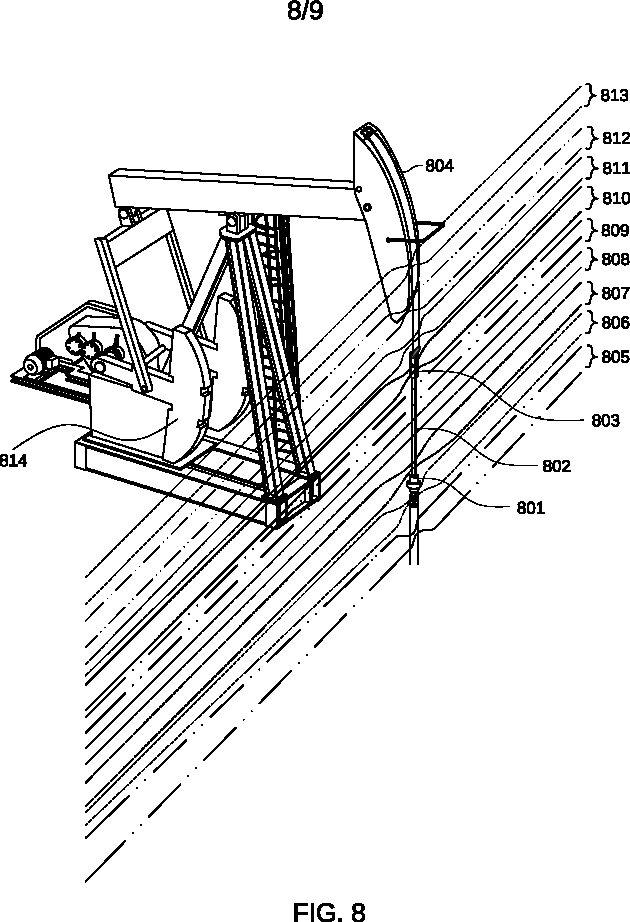
The entire invention revolves around detecting a “change of direction” from a magnetometer that produces a wiggling, sinusoid-ish signal. Their spec asserts that this signal “can be monitored to determine” when the rod changes direction — and then the disclosure stops. That's it. It recites the result and skips the how. But that magnetic field environment is a mess: there's moving steel all through the system, the field drifts in direction and magnitude along the whole stroke, and their spec never teaches how to tell the sensor's own motion apart from every other metal thing moving nearby. Saying the signal “can be monitored to determine” a direction change, with no teaching of how you pull that needle out of that haystack, is not a disclosure. It's a wish. That's the textbook enablement failure: claiming a result — the signal “can be monitored to determine” a direction change — while leaving a skilled person to undue experimentation to actually get there. That's the Wands standard (In re Wands), and it's a more basic problem than the broad “full scope” failure in Amgen: you never even reach scope when the how was never taught at all. I walked through exactly why that's so hard in Dispatch No. 13, and I drew the picture (my Figure 8) that they didn't. Did you see their figures? They are also thin, unenabled garbage.
Three figures that reveal the problem
The figures don’t cause the § 112 problem — they reveal it. What you see when you look at them makes the thin disclosure obvious. Part of the § 112 disclosure obligation is that you need figures where they’re necessary to understand the invention. OK, they provide 3. Could you disclose this invention with only 3 figures? Maybe, but not with these 3 figures. This is easy. Let’s go through them.
Figure 1 — an overview — Definiteness

They didn’t copy this from me, but I’d be shocked if it wasn’t lifted from someone else. This is just a generic overview. A typical pumping unit. You can see the counterweights at… uhhh… well, they didn’t label them. It’s the hatchet-shaped thing between 110 and 170. That’s a big ol’ chunk of steel that, relative to the sensor, changes direction. Technically it’s rotating so that means it’s always changing direction, but I’m not splitting hairs. In this illustrated position they are closest to the sensor and at some point they are farthest from the sensor. The magnetometer sees that.
The point is that the counterweights are at least something that changes direction (parsable from the magnetic field readings), but do we know if that’s what they are referring to? It’s unclear. That counterweight is closely related to the stroke, but the ambiguity renders the disclosure indefinite. Exactly what is changing direction and how do you enable determination of that? No answer can be found in the disclosure. § 112.
Figure 2 — a block diagram — Enablement

I have one of these. They didn’t copy it (at least not verbatim like the other copying). This figure really adds nothing to the enablement. I at least go to the trouble of showing the types of sensors and how they fit in the larger system. Their Figure 2 component/subsystem is about as generic as you could possibly get. These subsystems exist in a larger block, but how are they connected? What is the data flow? What do they contain?
I don’t necessarily have a problem with this figure. I have a problem with it being the only substantive illustration of the actual thing… it doesn’t enable anything. It's as vague as the text that describes it.
This should have been a § 112. Not this image alone, but that this was the only image.
Figure 3 — a linear flow chart — Enablement

Remember how this process repeats. I’ll readily say you don’t have to do it every stroke. The whole point of my disclosure is that you could defer sensing to optimize battery life. But you need to repeat this periodically. Any period. Once a day? Once an hour? Once every Nth stroke?
No, this 3-box flow chart terminates with no loop-back and no repeat trigger — the disclosure teaches a single execution and stops. A flow chart can be called repeatedly, of course, but that repetition has to come from somewhere: a caller, a scheduler, a loop in the spec, a described trigger. None of that is here. A skilled person reading this disclosure is left to supply the repetition themselves, which is exactly the undue experimentation the enablement requirement prohibits. There’s a repetition that is not illustrated. Enablement failure — § 112.
Lack of figures ≠ § 112
The figures aren't the failure — they're just the tell. You can pretty much see my § 112 issues with this application in just the figures alone. I’m not expecting a lot, but just look at them. Doesn’t this scream § 112? Not exactly, but it should raise the concern.
To be clear, the lack of figures does not trigger § 112, but the alarm bells should have sounded during examination. The actual textual disclosure is as thin as these figures. That’s a problem.
The timing problem — you can only know after — Enablement

Still on enablement — here’s the timing problem that makes the missing “how” even sharper. And all of this starting and stopping detection is supposed to happen in real time. Remember, they start and cease sampling of rotation at exactly a change in direction (presumably a vertical direction, but not crystal clear). Analogy: Go on a rollercoaster and close your eyes. When do you know you changed direction (vertical direction, i.e. peaks and valleys)? That’s right… after you actually changed direction. You can’t tell the rise or fall until you’re already into the rise or fall. A flat spot and a peak "feel exactly the same" at that moment. The magnetometer sensing is slightly different, but the delay to a positive detection is real.
To sense the change in direction properly, you need to watch the signal past the thing you’re looking for. Only after it really changes direction can you clearly see whatever it is that you see in that sine wave they briefly and cryptically mention (that’s the first part that wasn’t disclosed). That’s the problem with inertial sensors and why it’s so important to have someone who understands how those sensors work do the examination. They don’t magically (directly) sense the thing this application claims to sense. Clearly the examiner didn’t comprehend that here.
In the rollercoaster analogy, you might transition to a flat section of track, but not at a "global" peak. From an instantaneous perspective, they are exactly the same. They feel the same. This is a simple physics exercise. To determine a direction change, you need to look back at least one sample but probably many more to reduce false positives. That necessarily means you’ve sampled before and after the direction change. Even if it’s just one sample (but with a noisy signal, it is many more to avoid false positives). Their disclosure never teaches how to square that unavoidable delay with acting the instant the change occurs — and that missing how is the § 112 problem.
It gets even worse when it comes to their prosecution record, and I’ll explain this below. In short, important operable terms were switched in the arguments and in the claims. It’s subtle. Another in the long list of questionable actions.
If you are going to carve out something so specific — the particular chain of sensing events — you need to show how that actually works, otherwise it’s a textbook § 112! I still argue that I thoroughly disclose bounding the sensing to a single stroke, and that is well known to be defined by the direction changes (or any of the 100 other ways to phrase that). My disclosure anticipates their claim on this point under § 102. But we can still pick apart the claim in § 112.
More enablement — the "once"/"after" bait-and-switch
I talk about the physics realities of sensing above. This is where the reality comes crashing into the prosecution record through a staggering bait and switch on some key terms.
[Amended Claim 1]
sensing a direction change in the at least one component of the downhole pumping system to determine when a stroke of the at least one component of the downhole pumping system has been completed and to determine that a new stroke is beginning; andafter the direction change in the at least one component of the downhole pumping system has been detected, begin to determine rotation
After!!! "after the direction change"!!! — that's not what they say in the arguments. Now let me be fair: "after" is plenty definite — it just means "any time once you've detected the change" — and a merely broad term isn't an indefinite one. But that breadth is the tell on a different front. Immediately after? A few samples after? A week after? That's an enormous range, and the disclosure never teaches you how to operate across any of it. So the defect isn't really that "after" is fuzzy — it's the same enablement / written-description hole: an open-ended result with no how behind it.
The remarks could clarify “after,” and prosecution history is allowed to supply the very reasonable certainty § 112(b) asks for — Nautilus itself measures definiteness against the claims read in light of both the specification and the prosecution history. Read the prosecution history. It's not there either. Maybe it would have been if the examiner thought to raise it, but the world will never know.
Here's what they say in the applicant RCE remarks:
[RCE Remarks]
First, there is no disclosure in Phillips that rotation sensing only occurs once a direction change is sensed, indicating that a new stroke is beginning.Second, there is no disclosure in Phillips that the sensing then continues during a second change in direction.
Finally, there is no disclosure in Phillips of then ceasing the sensing once a third change in direction is detected.
"Once" (what they argued) and "after" (what they actually claimed). These terms do not mean the same thing — they sold the examiner a tight, gated "once" and walked away with a loose, open-ended "after" the disclosure never supports. The claim they got is broader than the invention they pitched. And for the record, I hate arguing over such a pedantic term. It's clear that this was disclosed by me years ago (§ 102). Even if you take the strict interpretation of "it has to be said exactly like this", it's obvious what this means when read by anyone who halfway understands science (§ 103).
There are ways to do this direction change sensing in a predictive approach, but that was nowhere near disclosed, let alone acknowledged as a concern or possibility. The end result was claimed with no "how to get there." That's a fundamental § 112!
- The full indefiniteness and enablement is in Dispatch No. 18: which “direction” even is it — the rod's linear reversal at the top and bottom of a stroke, or its rotational orientation? Nothing in the claim, or in how it was read to the examiner, tells a skilled reader which. That's the bind I press there: definite-and-anticipated, or novel-and-unintelligible — and to my mind they shouldn't get it both ways.
- The written-description / new-matter piece is Dispatch No. 20: their claim recites comparing against a “previous stroke,” but their own specification never describes that. You can't claim what your disclosure doesn't support.
Further below I'll cover two things those dispatches don't address: why § 112 is the interesting and clean ground, and why — maddeningly — it's the one defect I had no way to raise before the patent issued.
"Stroke" does double duty — a second definiteness problem
Definiteness again — § 112(b) — and this one comes straight out of their own text.
[Their disclosure]
[0047] … A reduced velocity of the rod rotator 180 may indicate an improper installation of the rod rotator 180, where a full stroke of the rotation mechanism of the rod rotator 180 may not be adequately occurring because of the installation orientation.
OK, so now there is ambiguity between the stroke of the pumping unit and the stroke of the rotator ratchet arm — the word “stroke” doing double duty for two different motions. That's a second, self-contained § 112(b) indefiniteness problem, sitting entirely within their own four corners, and it stacks right on top of the “which direction” ambiguity from Dispatch No. 18: a skilled reader can't say with reasonable certainty which “stroke” the claim even means.
The processor with no recipe — Definiteness, § 112(f)
This argument is aimed squarely at the processor — specifically claim 13's processor functions — not the sensor subsystem, and here's why. You could try the same move on the “sensor subsystem,” but it's a weaker target — “sensor” at least connotes a known class of physical thing (a magnetometer, a gyro), and their Figure 2 draws those subsystems as labeled boxes a patent owner will wave around as “structure.” Fine. But that very same Figure 2 shows the processor as a single box labeled “Processor 212” — and a box that just says processor is the textbook example of not an algorithm. So the processor leg survives the one figure they'd point to; the sensor leg I'll leave on the table.
Definiteness — § 112(b) via § 112(f). This one is specific to claim 13. Look at how that claim is actually built — claim 13's three processor functions:
- verify the axial movement;
- detect the rotational values during a current stroke; and
- compare this stroke's rotational values against a previous stroke's to determine if rotation has occurred.
A “subsystem” with nothing but a naked function bolted onto it is the classic nonce-word setup — the “black box to do the thing” drafting that Williamson v. Citrix (Fed. Cir. 2015, en banc) says gets treated as means-plus-function under § 112(f) whether or not they wrote the magic word “means.” And once you're in § 112(f), the rules tighten: the claim reaches only the structure the spec actually discloses for that function — and for anything a processor does, the Federal Circuit demands a disclosed algorithm, an actual step-by-step recipe, not just “a processor, which does it” (Aristocrat, WMS Gaming). So go look for their algorithm. It's not disclosed.
The cleanest gap is the "compare" function: how does the processor take this stroke's rotational values, find a “previous stroke,” compare the two, and decide whether rotation “has occurred”? What are the steps? There aren't any — the spec recites the result, names a processor, and stops. No algorithm means no corresponding structure, and no corresponding structure means the claim is indefinite under § 112(b) — a second, independent road to the same place, and one that (like everything else in this post) needs nothing but their own four corners to walk. And note what this doesn't lean on: it never reaches claim 1's sensors, and it doesn't ride on the “direction change” fight at all — claim 13 doesn't even use that term.
And to be clear about scope: claim 13 is the only claim where this no-algorithm angle lives — but the rest of the § 112 case isn't a claim-13 story at all. The missing “how” (enablement), and the “which direction?” and double-duty “stroke” ambiguities (definiteness), hit the other three independent claims right alongside it — claim 1, claim 16 (the tubing-rotator version), and claim 19 (the method version) — not just claim 13. § 112 isn't a one-claim problem here; it's spread across the whole patent.
The vibration sensor in three axes
I know, the vibration sensor again. Remember, I drew a diagram that I used for describing a magnetometer, an accelerometer, or a gyro in three axes, Figure 3. This was a point the examiner found novel (I still disagree because of the whole "an accelerometer is a vibration sensor" thing). But why use a 3-axis sensor at all? That's a fair question to ask in a § 112 context.
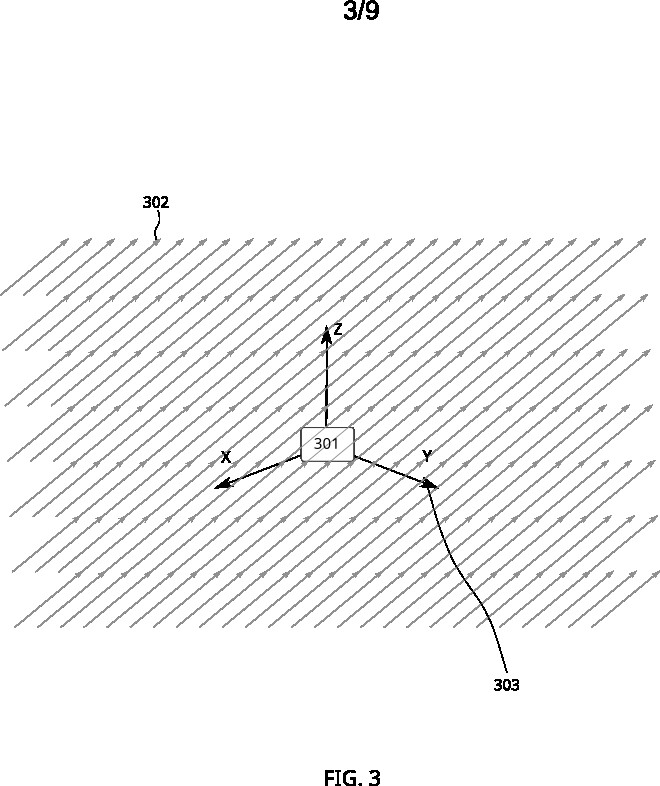
I probably could have done a better job explaining that myself, but here are two relevant passages:
[My disclosure [0081]]
[0081] … After calibration, a three-axis magnetometer can determine direction, or compass heading, of polished rod within the magnetic field.
Or how about this:
[My disclosure [0094]]
… A combination of these sensors can provide an absolute orientation of the sensing device 301 and its rate of change through the various frames of reference 302.
But what about their disclosure? Sure they call out a three-axis vibration sensor, but never say why or how it's used.
[Their disclosure [0028]]
[0028] … The vibrational baseline may be derived from the sensor (e.g., an accelerometer) in three axes during the stroke of the pumping unit. …
Sidenote: You see why I have a problem with the examiner's assertion that I don't disclose a 3-axis vibration sensor. They even call it out that an accelerometer is a vibration sensor. But that's not the point of this post.
The point of § 112 is to disclose the "how" not just that you bolted on something that does it 3 times. Doing something in three axes isn't patentable over doing something in one axis unless you add something to it. All they're doing is throwing in "three-axes" as a term, but not providing that "why" or "how."
[Their disclosure [0051]]
[0051] … vibrational baseline may be derived from the vibration sensor subsystem 214 in more than one axis (e.g., three axes) during the stroke of the downhole pumping system 100. …
They talk about rotation in a plane and how the polished rod rotates vertically and the tubing rotator shaft rotates horizontally. But you don't need a three-axis sensor for that. It gives you a better reading, but a single-axis (in the correct axis) could give you the desired result.
My issue here is that the examiner found this a point of novelty when the disclosure completely fails to provide any insight as to what is special about a three-axis sensor in this context. It's a § 112 (and maybe even a § 101), but the examiner bumbled it into a point of novelty (incorrectly, in my opinion). It's a complete failure of examination.
Why this should be a knockout
§ 102 and § 103 are strong, but they leave room to argue — wording, claim arrangement, which embodiment a sentence lives in. I think I'd win those (see Dispatch No. 22 and Dispatch No. 23), but they're a fight.
§ 112 doesn't turn on a prior-art fight at all. It's judged on their four corners: the only question is whether their specification teaches what their claim covers. It doesn't. One honest caveat — and it's why I lean hardest on written description and definiteness: enablement alone lets a skilled reader fill gaps with what the field already knew, so the applicant's escape is “a person in this art already knew how.” But the hard part — pulling that direction-change needle out of a haystack of moving steel and a drifting field — is the how their four corners never supply, and written description and definiteness don't hand them even the “a skilled person already knew” escape. There's nothing for them to point at but the disclosure that isn't there.
And here's the part that still gets me — I couldn't even say so!
Remember the third-party preissuance submission I paid for, the one this whole blog opened with in Dispatch No. 1? It's the only tool the public gets before a patent issues. And by design, it can't touch § 112.
A preissuance submission under 35 U.S.C. § 122(e) lets you submit “any patent, published patent application, or other printed publication of potential relevance to the examination of the application” — plus a concise description of the relevance of each document. That's the entire mechanism: documents, and a factual description of why each one matters. The rules are explicit that you cannot turn that description into an argument. Per MPEP § 1134.01, “the concise description of relevance required by 35 U.S.C. 122(e) is limited to a factual description,” it “is not an invitation to a third party to propose rejections of the claims,” and it “must not rise to the level of a protest under 37 CFR 1.291.”
A § 112 defect isn't a document. There is no piece of prior art I can drop in the file that proves their specification fails to enable their claim — the failure lives entirely inside their own disclosure (and I suppose the examiner who should have known enough to question this). The one preissuance channel open to the public is built to surface prior art, i.e. §§ 102 and 103. It is structurally incapable of raising enablement, written description, definiteness — or, for that matter, § 101. There was no box on the form for “their own spec doesn't teach this,” and if I'd tried to write one in, it would have been bounced as an improper protest. If an examiner wants to allow a time machine, no one can correct that before it snowballs.
So tally up who could have raised the strongest ground before this patent issued. The examiner could have — and raised none (back to Dispatch No. 2). The public — me — was structurally locked out by the very rules of the only tool available. That leaves exactly one proactive door, after the fact, with a roughly $60,000 toll on it: the PGR. And it really is just the one — not even an inter partes review, the cheaper challenge with a far longer filing window, can reach this ground: by statute an IPR is limited to §§ 102 and 103 on patents and printed publications, so § 112 is categorically off the table there too. The PGR's nine-month clock is the only administrative shot at the strongest argument I have. (Yes, § 112 is also an invalidity defense in court — but only if someone sues me, and no one has; you can't raise a defense to a lawsuit that doesn't exist. The deck is stacked tightly enough that I can't even get hauled into court to make the argument for free.) The best argument against this patent is one nobody was allowed to make until the most expensive possible moment. If you want one clean illustration of how the deck is stacked against the inventor, that's it.
Related dispatches
- Dispatch No. 1 — I tried to prevent this mess — the preissuance fee I paid, for the tool that structurally can't raise this ground.
- Dispatch No. 2 — Why a PGR? — where I first flagged that the examiner raised no § 112 at all.
- Dispatch No. 13 — You Still Don't Believe Me About the Direction Change Thing? — the sinusoid “leap” their spec never enables.
- Dispatch No. 14 — My Apology to Good Examiners — the examination that raised zero § 112 objections.
- Dispatch No. 18 — Indefinite and Unenabled — the worked § 112 case: indefiniteness and the unenabled “leap,” in full.
- Dispatch No. 20 — New material, not in the disclosure — the “previous stroke” written-description / new-matter problem.
- Dispatch No. 21 — § 101 — What Even Counts as an Invention — where I noted the same hollowness looks like § 101 but really lands here.
- Dispatch No. 22 — § 102 — Nothing New Here — where prior art anticipates their claims under § 102.
- Dispatch No. 23 — § 103 — Obvious to Anyone in the Field — the previous dispatch; the backstop ground this one closes out.
- Dispatch No. 25 — TL;DR; §§ 101, 102, 103, and 112 — the one-page recap tying it all together.
- Dispatch No. 26 — TL;DR; All the system failures — the recap of every system failure; the never-raised § 112 is one of them.
- Dispatch No. 28 — Let's Fix It — the proposed fix: make a full, thorough § 112 disclosure mandatory.
- Dispatch No. 29 — Independence Day — the coda: this § 112 bargain is the end they never held up.
- Dispatch No. 31 — Word Count — the word cap, and the fear this § 112 travesty gets cut for space.
- Dispatch No. 33 — The PGR Petition — the unfiled petition, and why this ground now never gets examined at all.
Discussion