
Dispatch No. 19 ← Previous ↰ All Next →
Bounding to a single stroke


The claim fences the sampling into a single stroke — first, second, third change of direction — but I disclosed that too. Actually, it's inherently contained in the stroke.
Background — part of my pro se Post Grant Review of U.S. Patent 12,460,537, which I believe copies rotation-sensing I disclosed first. This one takes on the “novelty” the patent leans on — bounding the sampling to a single stroke — which I'd already disclosed (it's inherent in the stroke). New here? Start at Dispatch No. 1.
Literally everything we do is tied to a stroke
Day one as a POSITA, you learn about the plot in the picture above. See how it loops around. We call that a dyno card. It gives us a view of how the pump is performing over a single stroke. That's important because the strokes repeat, so if you can look at one clearly, you can tell something. This concept is so fundamental, companies have put cheat sheets on mouse pads for tradeshow giveaways. Doing something during a stroke is the most common and obvious thing. There are lots of ways to dice up that continuous data stream into a stroke.
Bounding to a single stroke

OK, so you're thinking: but maybe they really did add something novel. The specific change in direction bounds something and does a more specific task. That's what the patent system is for. To build on previous technology. The problem with these sorts of "we painted it orange" patents is they devalue the original patent. It's not even a genuine design-around patent. This is just wordsmithing.
A workaround is valid… This isn't a workaround
OK, let's say they added some feature. If it's non-trivial, cool… but if it's trivial like "we painted it orange" that's a problem. I think I've made the case that this patent's sole purpose was to water down my claim to my exclusive rights as an inventor. If you read their disclosure, ask yourself: did they contribute anything to the collective knowledge and understanding of technology in the field? Something that wasn't already there (i.e. in the prior art)?
Heck, you could argue my application was a "paint it blue" on the earlier switch-based approach. My examiner argued that… at great length. I did non-trivial innovation by applying inertial sensors to sense this in a completely new and self-contained way. Multiple different ways, in fact. I thoroughly disclosed it. I should get the benefit of that Constitutional bargain. Article I, Section 8, Clause 8.
I didn't say I only detect rotation on days that end in "y", but apparently you could claim everything plus that and get issued a perfectly valid patent. That's effectively what happened here.
How many ways can you state the same thing?
I'll get to the § 102 standard (which was misrepresented) in a future post. For now, just believe me when I say a stroke means a well-known thing. Cutting up a continuous motion into distinct, repeating sections is also well known.
Detecting rotational torque — More specific
Remember, my disclosure was very thorough. There was a lot to disclose. Heck, I even had another way to determine rotation from RF signal strength (like watching the bars on your cellphone). That, in my view, got copied too — just like this, but by a different company. That just happened about a year ago. I haven't even gotten into that story yet.
I also had a section on detecting rotational torque buildup. This one is critical to the whole during a stroke thing. Remember, I talk about "over a stroke" 20 times. Multiple ways, multiple paragraphs. It bears more than a fleeting dismissal from the examiner.
The bulk of my disclosure revolves around detecting if the thing is even rotating at all, and for that alone you don't need to parse the individual stroke. But there are reasons to parse out the stroke.
I could go off into the weeds again, but I'll just provide a very specific example from my disclosure.
Intra-stroke… within a stroke
My degree is in Computer science (remember Dispatch No. 3?). I'll freely admit, I'm dragging in a term that is not-so-common to the rod pumping world. It is in the automation world, though, so a POSITA (with both rod pump and automation experience, which is common) would understand. If you asked, "what is meant by this?", they'd probably scratch their head and 5 seconds later they'd say: "Oh, I get it, that's within a single stroke… we do that all the time."
Here's the analogy: Internet vs. Intranet. Inter is between. Intra is within. Or maybe a patent example: Inter Partes Review (IPR). Inter here is between. But Intra-stroke… That means within the stroke, which means you have to bound the stroke. You can't not bound the stroke to get data within that stroke!
I say "Intra-stroke" 6 times. That means "within the bounds of a stroke"… 6 times! Heck, it's even in a claim. Here's that line from my claim 15:
[my claim 15]
the processor is configured to receive signals from the sensor indicative of instantaneous rotational deflection of the bridle assembly during stroking, and process those signals to detect intra-stroke torsional deflection over time, indicating a buildup of torque in the rod-string.
That's exactly what they are claiming. Looking at the rotational deflection within the bounds of a single stroke. I'm further clarifying here that this changes over time. They make it seem like you can just do it once… which you can, but that's useless information for the sake of detecting any change if it's not repeated. Think about a fire alarm that only ever checks if there is a fire once, and never again. It's an ongoing process.
Here's why it's confusing: It's bounding to a single stroke for one part (sensing something "right now"), but it's also doing this over subsequent strokes because it's useless to just know what something is doing right now… only once… never again, when you are looking for a change of state. You have to keep checking that thing. You don't have to constantly check it, but you need to do it periodically (i.e. start and stop the sensing because you care about saving battery life). I'll get to my Figure 6 in the next post, but I drew that as a looping flow chart to illustrate this exact concept.
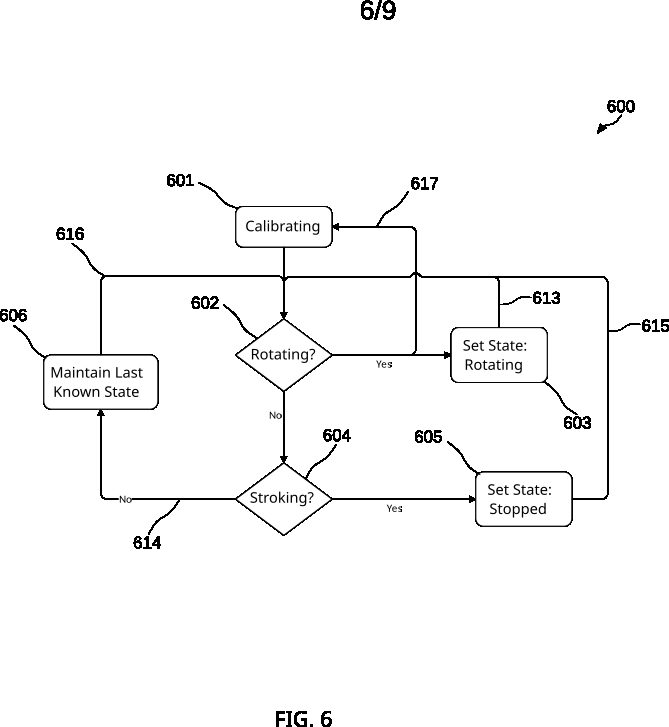
And notice what this lands on. The one limitation their allowed claim leans on to look new is comparing this stroke's rotational values against a previous stroke's. That puts them in a vise. Either comparing across strokes over time is already here in my disclosure — it is; that's the “ongoing process” I just described, and my looping Figure 6 — in which case it's anticipated; or it wasn't in their own original disclosure and they bolted it on later, in which case it's new matter they were never entitled to (the subject of the next dispatch). Anticipated or new matter — it can't be the thing that saves the claim either way. (These are pleaded in the alternative, not stacked — the Board only has to land on one; I'm not trying to bank both on the same limitation.)
And I further constrained this to a secondary phenomenon of torque buildup so they ended up with a broader claim for something I claimed more specifically. That's crazy, isn't it?
Directional reversals
Stick with me here because I'm going to show you exactly where I disclose this, and it's one of those Oxford comma deals.
From my application/patent:
[0081] … After calibration, a three-axis magnetometer can determine direction, or compass heading, of [sic - oops, I make typos too] polished rod within the magnetic field.
Did that mean direction plus heading or direction, a.k.a. heading? The examiner ignored it. But at the very least, the wording is too on-point for the examiner to have skipped citing it in an Office Action. This reads directly on their argument.
And before anyone throws Dispatch No. 18 back at me — yes, over there I argue their “change of direction” is indefinite, and here I'm reading my own “direction, or compass heading” nice and broad. That's not having it both ways. A claim has to be definite — that's the whole notice function of § 112(b). A specification is supposed to be expansive: it can describe several things, several ways, and that breadth is a feature, not a defect. Disclosure breadth is the point; claim ambiguity is the problem. Different documents, different jobs. And the asymmetry runs this way for a doctrinal reason, not a convenient one: a piece of prior art counts against a later patent for everything it actually teaches a person of ordinary skill — every embodiment, every alternative it spells out and enables. A broad, many-ways disclosure like mine is therefore more anticipating, not less — each thing it genuinely teaches is separately available as prior art (each still has to line up with the claim the way Net MoneyIN requires, which I take up below). The very breadth that would be a problem if I were trying to claim it is exactly what makes it deadly as prior art.
The very next paragraph (again my application/patent) says:
[0082] The sensor may further comprise an accelerometer, a gyroscope or a barometer. An accelerometer can be used to detect the accelerations imparted by the directional reversals caused by stroking action. A 3-axis gyroscope is similar to a 3-axis accelerometer, except the frame of reference is a static inertial frame. A barometer can measure changing air pressure indicating the rise and fall of the sensing device. These sensors aid in identifying vertical, cyclic motion of the polished rod 101, and thus indicate that the pumping unit is stroking and rotation is accordingly expected. The magnetometer experiences a range of field distortions as the sensor moves closer and further from steel objects in the pumping system. Short term variation in the magnetometer readings can therefore also be indicative of stroking action.
Again, for F&*%$ sake, it's right there in black and white in my application! Read this, coupled with the intra-stroke disclosure above, and tell me it's not exactly what they are claiming in the whole 3 directional reversals thing? Or just look at Figure 8; that shows it all in a glance.
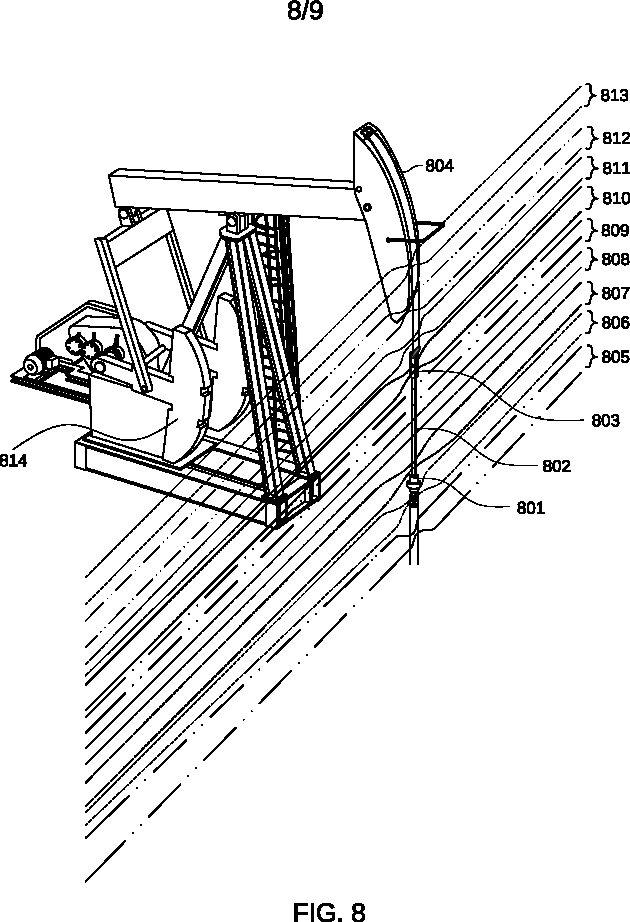
One lawyerly caveat, so I'm not overselling it: for a § 102 anticipation it isn't enough that every piece shows up somewhere in my disclosure — the pieces have to be arranged the way the claim arranges them (that's the rule from Net MoneyIN). I think they plainly are, and I'll walk that arrangement element-by-element when I get to the § 102 case. For now I'm just establishing that the raw materials are all here, in a single reference, in black and white — the arrangement argument is a short step from there.
Related dispatches
- Dispatch No. 3 — A Man Who Is His Own Lawyer Has a Fool for a Client — going it alone, pro se, against a corporate applicant.
- Dispatch No. 13 — You Still Don't Believe Me About the Direction Change Thing? — the "direction change" / stroke argument.
- Dispatch No. 18 — Indefinite and Unenabled — the § 112 indefiniteness and enablement case.
- Dispatch No. 20 — New material, not in the disclosure — the undisclosed "previous stroke" material that builds on this single-stroke bounding.
Discussion