
Dispatch No. 13 ← Previous ↰ All Next →
You Still Don't Believe Me About the Direction Change Thing?


Let's look at claim 7, because that originally contained the "allowable" material. Plus it defines what a stroke is. Their own definition confirms it.
Background — part of my pro se Post Grant Review series on U.S. Patent 12,460,537. The patent's “allowable” subject matter hinges on a claimed “change of direction”; I say that just restates the pump stroke I'd already described in my own disclosure. This one proves it from the applicant's own Claim 7. New here? Start at Dispatch No. 1.
Remember, in Dispatch No. 8, I mentioned claim 7 because that formed the basis of the allowable material. Interestingly, it also makes a very pointed case that my whole “walking” analogy is accurate — that taking a step is the same as lifting your foot, moving it forward, setting it down. In other words, the applicant basically says they mean the same thing. It's right there in claim 7 and I'll get to this below. Claim 7 says that the stroke is defined by these direction changes.
Could you start taking a step with your foot off the ground? I suppose you could argue that, but does it make any sense? No, everyone knows what it means.
In Dispatch No. 9 I showed that the examiner allowed Claim 13 for reasons that point to a “first,” “second,” and “third” direction change — language Claim 13 simply does not contain. If you weren’t convinced, this one is for you.
What is a direction change anyway?
First, you have to know the motion of this system is mechanically bound. It's a common four-bar linkage problem. The thing goes up and goes down because rotary motion is transferred to linear motion. This concept is thousands of years old. I don't need to go into the weeds of this. Suffice it to say the direction change is a fundamental action that this thing does. That being said, the "direction change" isn't even very well defined in their disclosure. I'll get to this below.
Three direction changes

What does this mean? You could write it a thousand different ways, all of which would probably convince at least one person it's somehow a novel process. "Return to the same starting position" … "Cross a zero velocity"… "when the sum of the displacement equals zero"… All sorts of convoluted phrases that fundamentally mean the exact same thing.
You could call it a "cycle"… I call it a "stroke" (and so does every other POSITA).

The whole "keep doing what you're doing" at a 2nd change seems like unnecessarily complicating the verbiage to make it sound fancier. This is why my walking analogy from Dispatch No. 8 is applicable. It's describing a thing we all know, but with extra words to make it sound like something more than it is. That thing is there by definition. You can't walk without lifting your foot… unless of course you're Michael Jackson. Too soon?
Let's get into the real arguments for why this direction change nonsense is flawed at a much deeper level.
Claim 7 — the direction change
Sorry, I need to write it out. This is the claim that was moved to claim 1 to magically make it novel.
- The sensor system of claim 5, wherein the processor subsystem is configured to continue sampling the rotational velocity along substantially an entire stroke of the at least one rod, the sampling beginning at a first change of direction of the at least one rod, continuing through a second change of direction of the at least one rod, and ceasing at a third change of direction of the at least one rod.
I anchored my measurements to the stroke, by name, about 20 times in my application — “over the course of a stroke,” “during the course of a single stroke,” “over a single stroke,” “intra-stroke” (go count for yourself). What this “course of a stroke” means to a POSITA is painfully obvious. But you don't have to believe me. The definition is right there in their claim 7.
[Their application, claim 7 above]
along substantially an entire stroke
They admitted it, right there
Can we just agree that this means “over the course of a stroke”?
And this isn't just me waving my hands — it's a claim-construction argument. The claims are the strongest evidence of what the claims mean, and a patentee gets to act as their own lexicographer; here the applicant's own claim 7 defines the stroke by spelling out its boundaries (“along substantially an entire stroke… first… second… third change of direction”). A patent lawyer will counter with claim differentiation — the idea that because “stroke” and the “first/second/third change of direction” appear in different claims, they must mean different things, so “stroke” alone can't already include them. Nice try, but that presumption is rebuttable, and claim 7 rebuts it on its face: it doesn't treat the direction changes as some extra feature bolted onto a stroke — it uses them to define the span of the stroke itself (begin at the first, continue through the second, cease at the third). That isn't two different scopes; it's the claim telling you what a stroke is. And the reason it can is physics: a stroke is its direction changes.
I don't specifically say along substantially an entire stroke, but I do say it a bunch of different ways: “during the stroke”, “single stroke”, “over the course of a stroke”, etc.
Heck, I even say "stroke-induced rotational deflection" which alone pretty much sums up (or rather rebuts) all of their arguments.
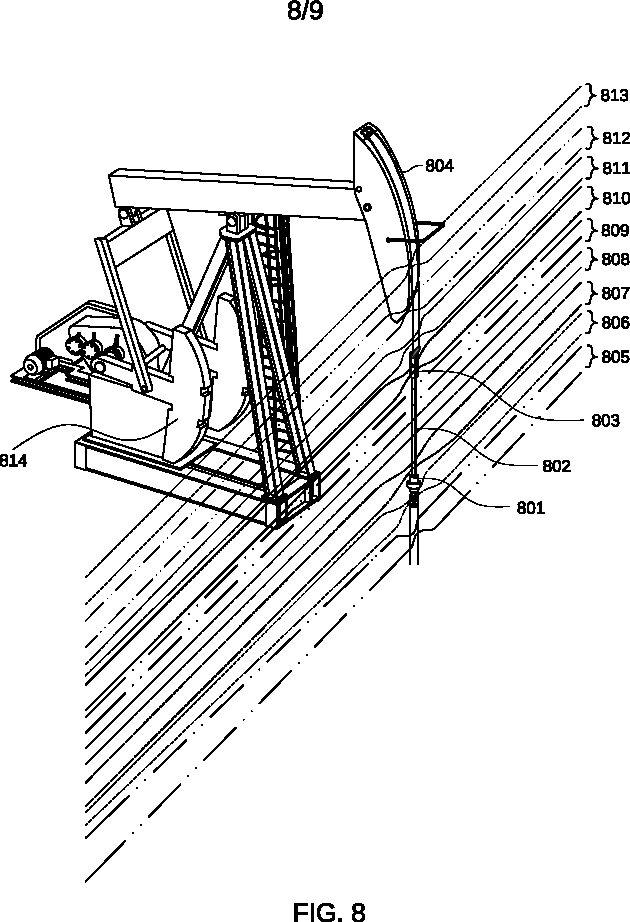
I also map out "how" you would sense this as you can see in my Figure 8. This one is so important I included it in the prior art submission "concise description". I also say this in my application. This is literally prior art that the examiner didn't use:

[My application]
It can be seen that the magnetic field observed by the sensor can be substantially different in both direction and magnitude depending on the location of the sensor along its path of travel. This can yield significantly erroneous readings if not properly addressed through calibration.
I drew a frickin' picture of what it looks like. That's important. To get a patent you (at least in theory) are supposed to teach the world how to do it. You can't just claim the conclusory results of something (yes, subject of a future post… again).
Relevant disclosure
Here's the relevant sentence from their disclosure. Their disclosure isn't very detailed, so this one is easy.
[Their application]
[0039] The sensor subsystem 204 may include an axial motion sensor subsystem 206 including one or more sensors for detecting linear movement (e.g., a magnetometer, a capacitive sensor, a Hall effect sensor, an optical sensor, etc.). For example, the axial motion sensor subsystem 206, which may be contained in the sensors 175, 185 may be coupled to one or more components (e.g., the polished rod 135) of the downhole pumping system 100 to detect axial movement of the polished rod 135 of the downhole pumping system 100. In embodiments where the axial motion sensor subsystem 206 includes a magnetometer, the axial motion of the polished rod 135 may be monitored based on variations in a magnetic field detected by the magnetometer generated by movement of the polished rod 135 of the downhole pumping system 100. For example, the magnetic field surrounding the polished rod 135 and the nearby metallic structures (e.g., the wellhead 125) may provide a sinusoidal-type waveform in the magnetometer that can be monitored to determine when the polished rod 135 changes axial (e.g., vertical) direction (e.g., during an up and down stroke of the polished rod 135).
I could go sentence-by-sentence and show where I disclose every single element. The only thing in this paragraph that I do not explicitly state is the bit about the sinusoidal-type waveform. I'm not exactly sure how that happens "in the magnetometer," but sure. Note: there's a § 101 angle in here too, but it's the least compelling of all of my issues with this application — background commentary, not a ground I'm raising in the PGR. Still, the examiner should have at least looked (future post… sorry I keep saying this).
It's complicated
The problem is that just watching a sine wave tells you nothing about a change in direction — only about the magnetic field. This could change because of rotation. It could happen in addition to linear proximity changes. There's moving steel all through this system, so the magnetometer also sees direction changes of other moving metal things, and those are indistinguishable from a direction change of the rod itself. You can't just magically make those go away.
The whole thing is very complicated and this single sentence does not even begin to enable that conclusory statement of "can be monitored to determine … changes … direction".
That is a § 112 problem — indefiniteness, written description, and enablement. That is a big one, so I'm giving it its own post.
I'll come back to the mischaracterizations too, because it's mind-boggling how they bamboozled the examiner. There's so much more to talk about here.
Super pedantic
OK, they start sampling at a change in direction… meaning they aren't sampling before that change in direction occurs… And "ceasing" sampling is not entirely accurate since this process necessarily repeats. So for it to technically work, you aren't ceasing, you're pausing… because you are going to repeat this process. I'm not hanging my hat on that argument either, but you can see the cracks starting.
Related dispatches
- Dispatch No. 8 — Back From the Dead — how this claim came back from the dead.
- Dispatch No. 9 — The Overly Broad Claim Slipped Through — why the allowed Claim 13 doesn't contain the "direction change" language.
- Dispatch No. 15 — Strapping Cell Phones to Oil Wells — those same direction changes, out on a real pumping unit.
- Dispatch No. 18 — Indefinite and Unenabled — the § 112 case: indefinite and unenabled.
- Dispatch No. 19 — Bounding to a single stroke — bounding the sampling to a single stroke.
- Dispatch No. 21 — § 101 — What Even Counts as an Invention — the sinusoid / direction-change leap, seen through § 101.
- Dispatch No. 24 — § 112 — They Never Said How — why that unenabled “leap” is the § 112 knockout.
Discussion