
Dispatch No. 18 ← Previous ↰ All Next →
Indefinite and Unenabled


The § 112 problem the examiner never reached: a claim a skilled reader can't pin down, on a disclosure that never teaches the method.
Background — part of my pro se Post Grant Review series on U.S. Patent 12,460,537, which I believe copies rotation-sensing I disclosed first. The patent claims detecting a “change of direction” from a magnetometer signal. This one is the § 112 case: the term is indefinite and the disclosure never teaches how to do it. New here? Start at Dispatch No. 1.
§ 112 — Enablement
This is why a Post Grant Review is important. I get to point out that the written description is wholly inadequate. That alone should have sunk this application and the examiner never applied it. Only § 102 and § 103 objections (and not very well on those).
As far as I can tell, the PGR and its ~$60,000 price tag are the only avenue for challenging a document that just doesn't teach what is claimed — i.e., § 112. This is an utter failure of examination.
And that's not loose talk — it's structural. The cheaper post-grant tool, an inter partes review (IPR), is by statute limited to § 102 and § 103 grounds based on patents and printed publications. You literally cannot raise § 112 — enablement, written description, indefiniteness — in an IPR. A PGR is the only post-grant proceeding where this ground is even on the table, and its window is just nine months from issuance. Miss it, and the most fundamental defect in this patent becomes effectively unchallengeable short of a lawsuit.
It's worth going back to read Dispatch No. 13 for this one.
§ 112(b)
Let's start with § 112(b): indefiniteness. The whole claim turns on (as the attorneys say… I'd say "rotates on") a “change of direction,” but it never says which kind of direction — the rod reversing its linear travel, or its rotational orientation? A magnetometer is a 3-axis sensor; it can act as a compass, so the “direction” it natively reports, as it would commonly be used (without a substantial explanation of how it's sensing something else), is rotational. In other words, a change in the direction it's pointing relative to the earth's magnetic field.
Before you say "oh, but they are clearly talking about axial direction", know this: the physical assembly also twists at/near the ends of stroke, so there are two types of direction changes happening at the same time… in the same place… exactly where they claim to detect a change in direction. That the rotation occurs at the end of stroke? That the signal changes with proximity to something? I can ask many questions to illustrate how little they disclosed about this.
That's something a POSITA would be needed for. Or you could just read my disclosure where I actually talk about all of this. And here's the problem with their disclosure. You can't tell what the heck they are sensing or how, or if they are processing the signal for something. It's just a magic conclusion that a magnetometer somehow senses some sort of direction change and that's somehow related to a sinusoid.

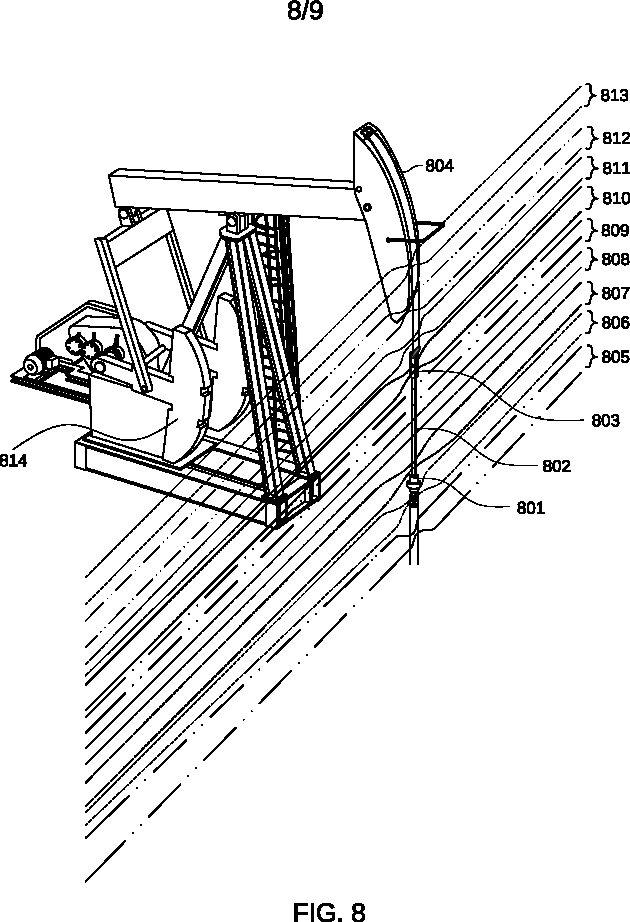
Note: the applicant mischaracterized my disclosure by calling attention to the description of the magnetometer acting as a compass. As you can see in my Figure 8 (in Dispatch No. 13), I talk about how it can also be used to determine linear position. Position can be further determined over time in terms of a velocity, or phrased as a direction change if you want to get pedantic. Position, velocity, and acceleration are all mathematically related. It's high school math, well within the purview of a POSITA. Again, this is all in my prior art description that I submitted to the examiner. Credit where credit is due: the examiner did point this out… once. Then apparently forgot. The examiner forgot a lot during this back and forth with the applicant.
Yet this same claim (their claim 7) is sampling the rod's rotational velocity. So when it says the sampling begins at a first change of direction, a second, and ceases at a third change of direction, does that mean the rod is reversing its linear travel — the top and bottom of a pump stroke — or its rotational direction? Those are two completely different things to sense, and they may occur simultaneously or close to simultaneously. Nothing in the claim — or in the disclosure — tells a POSITA which one is meant. A claim a skilled reader can't resolve with reasonable certainty is indefinite. That's not a nitpick; that's § 112(b).
These grounds run in the alternative, and the applicant shouldn't get to escape both ends at once. Unless of course the examiner ignores all of this.
Either “change of direction” is definite enough for a POSITA to pin down — in which case it just means the ordinary stroke boundary, the very thing the prior art (my own disclosure, and Fyfe) already taught. They even admit this in the original claim 7 by saying a stroke is bound by those direction changes, which is common knowledge. In that case the claim falls for anticipation under § 102 — or it genuinely is ambiguous between a linear and a rotational reading, and it's indefinite under § 112(b). Definite-and-anticipated, or novel-and-unintelligible. They don't get to have it both ways, and neither version survives a proper examination or review. I'll make the full § 102 anticipation case in a later dispatch; I'm trying to stick to § 112 here.
Full disclosure on my own argument: indefiniteness is the position I lead with on “direction change” — a serious, independent ground, not a throwaway. A determined defender will say the claim's own structure — a separate “axial motion sensor” and “rotation sensor,” with the direction changes bounding a stroke (which is an axial thing) — resolves the ambiguity with “reasonable certainty.” But that's exactly the trap from the paragraph above: the moment they say it's that definite, “direction change” just means the ordinary axial stroke boundary — the very thing my own disclosure and Fyfe already taught — and the claim falls for anticipation instead. Definite-and-anticipated, or ambiguous-and-indefinite; they don't get to have it both ways. And sitting on top of that is a second, independent failure that doesn't depend on the construction fight at all: even if “change of direction” were perfectly definite, the disclosure still never teaches how to do what's claimed. That's § 112(a).
§ 112(a)
And even if you decide “change of direction” is clear enough and referring to the linear direction, § 112(a) is the next problem. Written description asks whether their specification actually shows they possessed this — a real way to find that change of direction and sample around it — or whether they just grafted the words onto a disclosure that never describes the method.
Remember how this claim came back from the dead? Starting and stopping one type of sensing at a change in another type of sensing. Ooooh, that seems novel, right?
The key is equating what a magnetometer senses to a notion of movement or direction. A magnetometer doesn't provide that information directly. You can determine that from a magnetometer, but it's not a direct output. Sort of like how you can get position out of an accelerometer, but you have to apply some algorithm and understanding to get there. It's not just a magic box.
Enablement asks them to teach how to do it across the whole scope they claimed — and the Supreme Court drove this home in Amgen v. Sanofi (2023): the broader the claim, the more the specification must enable, across its full breadth. So if “change of direction” covers both the linear and the rotational reading, they have to enable both — from magnetic data that's inherently noisy, drifting in direction and magnitude along the entire path, and needing calibration and analysis to mean anything (I get into just how chaotic that environment is, with Figure 8, back in Dispatch No. 13).
And there is the fact that both "direction" signals are present in the magnetic field: linear direction change (which technically isn't correct, but I'll run with that for this) and rotational direction change.
That's the bar their spec has to clear. What the heck are you doing to pull out some actionable information from the magnetic field? Yes, it can be done, but they do not provide anything on the "how". It doesn't clear that bar: it merely recites the result and skips the how.
Whether I taught the how is a different question — that's my § 102 argument, not this one. For § 112(a), all that matters is that their disclosure doesn't. And the examiner should have seen this.
Related dispatches
- Dispatch No. 13 — You Still Don't Believe Me About the Direction Change Thing? — the direction-change argument and Claim 7 this builds on.
- Dispatch No. 19 — Bounding to a single stroke — bounding the sampling to a single stroke.
- Dispatch No. 21 — § 101 — What Even Counts as an Invention — why the unenabled "leap" is really this § 112 problem, not § 101.
- Dispatch No. 24 — § 112 — They Never Said How — the § 112 ground laid out in the context of the PGR.
Discussion