
Dispatch No. 20 ← Previous ↰ All Next →
New material, not in the disclosure

It looks minor — but a claim limitation that isn't in their own disclosure is the kind of defect that can sink a claim. Yet another examination failure.
Background — part of my pro se Post Grant Review of U.S. Patent 12,460,537, which I believe copies rotation-sensing I disclosed first. This one catches a claim limitation — the “previous stroke” — that appears nowhere in their own disclosure: new matter the examiner waved through. New here? Start at Dispatch No. 1.
New material
OK, if they want to split hairs about me not saying something exactly like they said it, here's one on them. And this one is legit. A claim element that was never disclosed. It involves the concept of a "previous stroke." Go ahead and look for that in their disclosure. Ordinarily I wouldn't get hung up on something this pedantic, but they did it to me, so this is fair play.
Unfounded argument
Let's look at The RCE, page 5:
[Their Arguments/Remarks from the RCE]
Further, while Phillips discussed some comparison of values, Phillips does not disclose using the value detected during a previous stroke to determine if rotation of the at least one component of the downhole pumping system has occurred. [Their emphasis, not mine]

I haven't even mentioned my Figure 6 yet. Here it is (see my Third-Party Preissuance Submission). The whole point of this invention is that you repeatedly compare this value over time. That's obvious… I think. Imagine if your smoke detector only reported that your house is not on fire once and then never checked again. In this case it doesn't have to be constant, but you have to keep checking it.
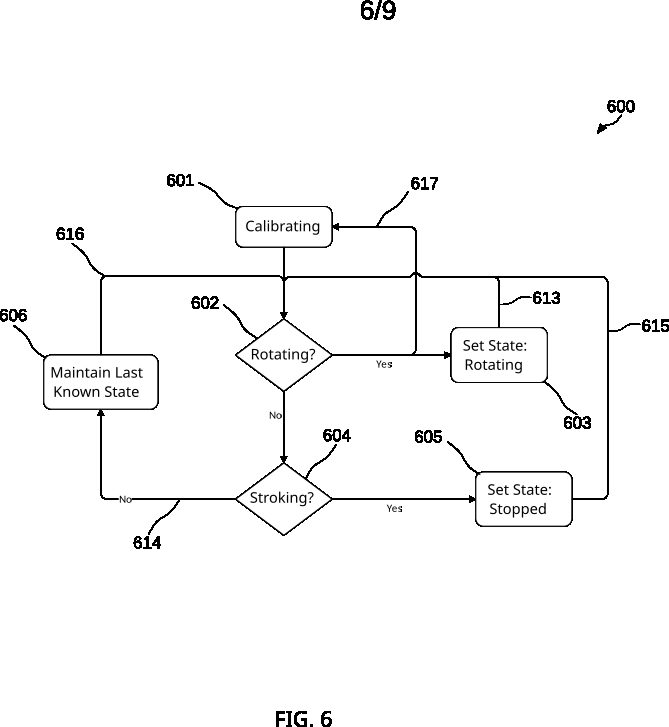
In my opinion that argument above, about the previous stroke, is pretty much false — and I think the record shows it. How so? Because A) I do disclose it, and B) they don't even disclose it in their application. I'll get to this below.
But first, my disclosure. Remember in Dispatch No. 19 I talked about the "Intra-stroke" concept (within a stroke). Here's a passage from my disclosure:
[My disclosure]
[0043] …A change in intra-stroke torsional deflection over many strokes, followed by a rapid reduction, indicates a buildup of torque in the rod-string due to frictional resistance down-hole, followed by a sharp reduction in deflection when the rotational resistance is overcome and applied torque is lost.
"Over many strokes" should be equivalent to "a previous stroke"… right? There's a previous stroke in there… in one of the many strokes.
But it gets better

Did they even disclose this?
No! It's not even in their written specification. They say stuff like "during an entire stroke" and "during the stroke" (which I state 20 times in various contexts in my disclosure). But in their disclosure, no "previous," no equivalent term. There's a "baseline," but that refers to vibration, not a discrete stroke. There's no illustrative drawing you can point to. Nothing.
But there is a very good argument that I disclose exactly this. Look at [0043] and my Figure 6 above. That is why it's so frustrating. Like with the vibration sensor, I did disclose it, but the examiner is acquiescing to the applicant's arguments blindly, or with the weakest of pushback. There was no way for me to correct these false statements as they were happening.
Two different concepts
One: their claim 13 recites “previous stroke,” but their own specification never describes that comparison — not in those words, and, more to the point, not in any form. That's a written-description failure under § 112(a): the spec has to show the inventor actually possessed what the claim recites (the Ariad v. Eli Lilly standard). I'll come back to § 112 in a future post. And to be clear about the doctrine, this isn't a magic-words game — written description never required the exact claim term. The question is whether the disclosure, in some form (text, an equivalent description, or a drawing), conveys possession of comparing one stroke's rotational values against a previous stroke's. Theirs conveys it in no form at all — recall: no “previous,” no equivalent term, no figure, just an unrelated “baseline” about vibration. You can't show possession, in writing, of a concept your written description never conveys. (The prosecution-side name for the same sin is “new matter” under § 132 — bolting onto the record something the original filing didn't support; in a PGR the ground actually pled is the § 112(a) written-description failure.) Critically, it's judged on their disclosure alone — what I did or didn't disclose has nothing to do with it; their claim simply isn't supported by their spec.
Two, and separately: to the extent that limitation means anything, I (and Fyfe) already disclosed the same comparison — that's the § 102/§ 103 lane, judged on either of these disclosures.
And so: their claim is unsupported by their own spec, and, independently, it isn't new. Either one sinks it; don't let me smush them together.
And don't lose sight of which limitation this is. “Previous stroke” isn't some incidental bit of wording — it's the one phrase the applicant added at the RCE that finally made claim 13 look different from everything before it, the hook the examiner hung the allowance on. Knock it out — as unsupported under § 112(a), or as already disclosed under § 102 — and there's nothing left holding the claim up. This isn't a peripheral defect; it's the load-bearing wall.
Equivalent terminology
You all know I'm not a lawyer, so preface this section (and this whole site) with that.
I don't even have a problem with claiming equivalent terminology. Like if the specification said "an earlier stroke" or something more complicated. But the specification completely lacks this notion of a "previous stroke." That's a bridge too far. Check their specification and tell me I'm wrong.
If you want to add terminology, you should at least argue the equivalence of that terminology in the prosecution. Say "this term means that." But they didn't even do that.
Hail Mary
I suspect this "previous stroke" argument was a Hail Mary aimed at the examiner, and it worked better than anyone should have expected (that's not good for the integrity of the examination process). Sneaking in material like this isn't cool. A lot of what transpired here isn't cool.† They just claim I don't say it — which, in my reading of my own disclosure, is false… I clearly do. Even if I didn't disclose it, that doesn't mean they get to claim it — remember, they don't disclose it. Maybe you can shed some light on it?
† That's my read of the prosecution, not a finding of intent — I can't see inside anyone's head, and (as above) I'm not alleging, and the PGR does not allege, inequitable conduct or any breach of the duty of candor. My narrow point is that “previous stroke” isn't in the specification, so it shouldn't have been claimed or accepted. ↩
Wrapping it up
They did not disclose comparing the rotational values with previously sensed rotational values detected by the rotation sensor subsystem during a previous stroke. You'll just have to believe me, but you can read their specification to double-check (if you find it, please tell me).
Recapping
[Their claim 13]
… comparing the rotational values with previously sensed rotational values detected by the rotation sensor subsystem during a previous stroke of the downhole pumping system to determine if rotation of the at least one component of the downhole pumping system has occurred.
That's not in the disclosure. It's not even argued that it could be interpreted from the disclosure. The argument is that I didn't say it explicitly, so they should get to claim it. That's the argument.
I have a lot of problems with Claim 13. The new material isn't even at the top of that list, but it is very easy to comprehend, just like what I see as plagiarism. These aren't innocent careless mistakes (at least not in my opinion).*
* That's my opinion, drawn from the public record — not a legal finding. I can't see inside anyone's head, so I'm not claiming, and the PGR does not allege, inequitable conduct or any breach of the duty of candor; my point is only that, to me, the record reads as more than simple oversight. “Plagiarism” is likewise my plain-English read of the side-by-side text, not a legal conclusion. ↩
Related dispatches
- Dispatch No. 6 — The Third-Party Preissuance Submission — where I laid out the prior art in detail.
- Dispatch No. 16 — Claim 13 — Again — Claim 13 had new material not in the disclosure. Not established in the record.
- Dispatch No. 17 — Let's Ask Claude — where Claude untangled the contradiction in the record.
- Dispatch No. 19 — Bounding to a single stroke — bounding the sampling to a single stroke.
- Dispatch No. 21 — § 101 — What Even Counts as an Invention — the next dispatch, reading this same "previous stroke" claim through § 101.
- Dispatch No. 22 — § 102 — Nothing New Here — the § 102 anticipation leg: to the extent "previous stroke" means anything, I already disclosed it.
- Dispatch No. 23 — § 103 — Obvious to Anyone in the Field — the § 103 obviousness leg of the same run through the statutes.
- Dispatch No. 24 — § 112 — They Never Said How — the written-description / new-matter problem framed as the § 112 case.
- Dispatch No. 26 — TL;DR; All the system failures — this new-material defect, gathered with every other examination failure.
Discussion